


When Does the Year-End Rally Actually Start?
The year-end rally often begins earlier than the media reports. A look at 66 years of DAX data and 98 years of S&P 500 data shows when opportunities really start to increase.
The year-end rally often begins earlier than the media reports. A look at 66 years of DAX data and 98 years of S&P 500 data shows when opportunities really start to increase.

Historically, the DAX has gained +1.72% in the 16 days following German elections, with an 80% success rate. As political uncertainty clears, market-friendly policies could fuel another rally. Will this election follow the trend?
Germany’s DAX index has dropped amid renewed trade tensions, particularly in the auto sector. However, history suggests that March through June is a seasonally strong period, with an average gain of +6.57% and a 90% win rate.

Discover the "Santa Claus Rally," a seasonal phenomenon with a history of boosting stock prices during the holiday season. Learn how it impacts markets like the S&P 500 and DAX, and what factors could influence this year's rally.

In this environment, many investors are turning their attention to economic indicators. One of the most important for Germany is the ZEW Index. More than 350 institutional investors are surveyed for their assessment of the economy. The ZEW Index is published monthly around the middle of the month.

The legend says that the phrase originally came from an old English saying: "Sell in May and go away, and come back on St. Leger's Day." This advice was linked to British aristocrats who used to leave the hot city of London during the summer and return after the St. Leger's Stakes horse race in September. What began as a lifestyle choice for the wealthy has turned into a financial strategy observed in stock markets globally.

As the end of the calendar year approaches, whispers of a stock market rally begin to circulate among investors and financial analysts. But is this so-called "year-end rally" a mere myth?
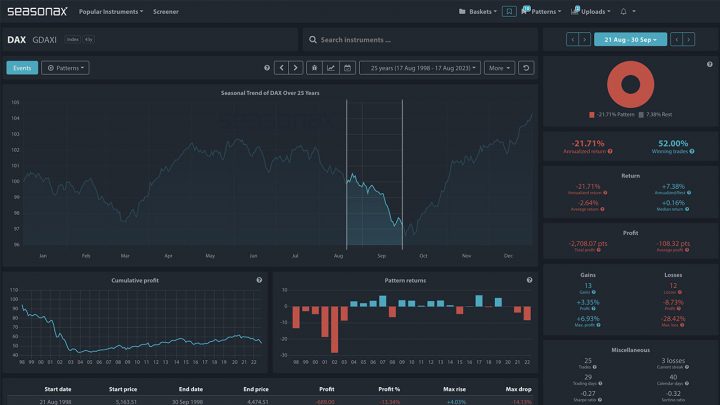
Over the last 25 years the two weakest months of the year for the Dax have been August and September. This year, at the time of writing, the Dax has fallen just over 5% so far. The question is will…

After gaining around 16% this year the Dax has rallied up to the highs from January 2022. However, there are increasing calls that the recent rise in stocks, particularly in the US, looks stretched. This has resulted in some calls…

Recently the Dax has been under pressure seeing solid days of selling on Tuesday and Wednesday of this week. US debt default risk, geo-political tensions, a gloomy German IFO print, and high UK inflation likely to prompt higher rates from…

Article in German Dear Investor, You may have heard of the so-called election cycle. This cycle, which is popular in the US, impacts stock markets for four years in a statistically significant way. Does anything similar exist in other countries?…


