


The Weakest Month has Begun!
At the beginning of August, the stock markets suffered a collapse. In fact, August is a seasonally weak month – since 1970 it has been the second weakest in the annual cycle.
But there is an even weaker month: September.
At the beginning of August, the stock markets suffered a collapse. In fact, August is a seasonally weak month – since 1970 it has been the second weakest in the annual cycle.
But there is an even weaker month: September.

Article in German Dear Investor, Volatility, the tendency of prices to fluctuate, is not just an academic construct – there are also products such as ETFs based on it. Volatility has recently been quite low by historical standards. Can we…

The next Fed meeting will take place in just over a week, from April 30 to May 1. In view of a higher-than-expected inflation rate, many investors are wondering whether the Fed will signal interest rate cuts this time, and by how much, and what this means for share prices.
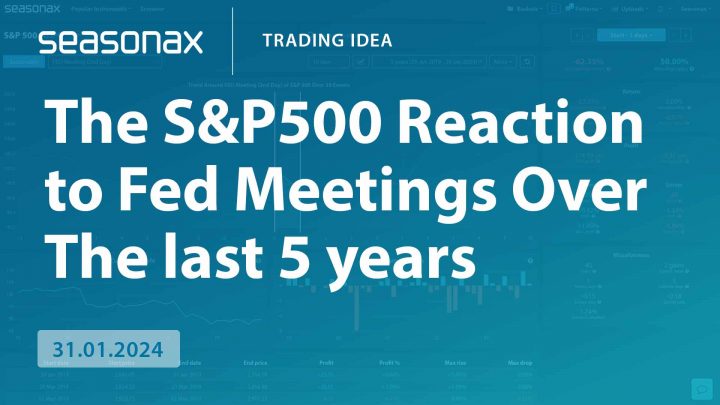
With so many uncertainties ahead of the Fed meeting it can be very helpful to see the reaction of the S&P500 over the last 5 years out of Fed meetings! The bias for heavier selling is clearly there, so this can help frame expectations on a surprise hawkish decision.

Today is the Federal Reserve’s hotly anticipated interest rate meeting. Expectations in short-term interest rate markets are for the Federal Reserve to cut interest rates four times next year. Now this seems a very dovish expectation.

As 2023 closed out, the financial world buzzed with optimism. The S&P 500 surged over 24%, and the Dow neared historic highs, fueled by easing inflation, a resilient economy, and anticipated lower interest rates. Notably, the market rally wasn't just about big tech names

Today is the Federal Reserve’s hotly anticipated interest rate meeting. Expectations in short-term interest rate markets are for the Federal Reserve to cut interest rates four times next year. Now this seems a very dovish expectation.

Yesterday we saw a big miss in the US CPI print which allowed the S&P 500 to move significantly higher on ‘peak Fed narrative’ hopes. Seasonax’s event feature allowed us to expect upside in the S&P 500 in the event of a miss and the same feature leads us to expect potential for dip buying in the S&P 500 today.
Over the last few days, markets have been confronted by a confused message. On the one hand, the Feds recent messaging has become more dovish indicating that the recent surge in yields could mean the federal reserve doesn’t need to hike in November. However, on the other hand, the PPI print on Wednesday surprised significantly to the upside indicating the Fed had more work to do.

August is widely known for its scorching heat and languid days. However, it often carries with it a unique behavioral pattern in the stock market. Historically, August has seen softer market movements, lighter trading volumes, and frequently a certain degree of pullback. But what drives these August anomalies? And amidst these fluctuations, which stocks remain promising investments?

As well as the seasonality of the year, there are other calendrical cycles such as the week or the month. Today, we are going to consider the performance of the S&P 500, analysed by looking at the days of the week from the year 2000. Believe it or not, there are individual days of the week that perform significantly better than others!

